Stefano Bartezzaghi
Stefano Bartezzaghi
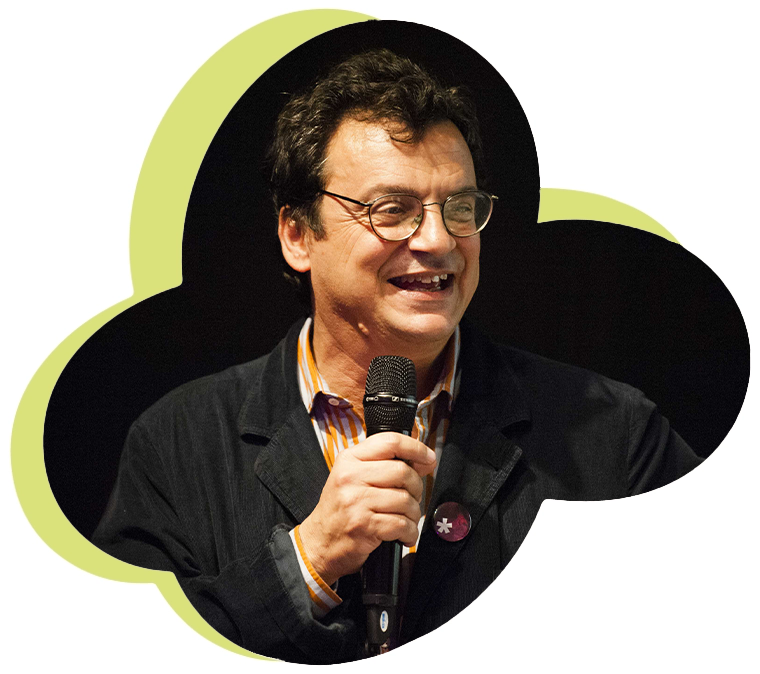
Biography
Semiologist, puzzle master, and essayist, he is among the most important scholars in the field of wordplay, humor, and creativity. Born in Milan, he began collaborating with all the main Italian puzzle magazines as an author and solver of games at the age of nine. Later in life, he graduated from the University of Bologna with a thesis in semiotics under Professor Umberto Eco. Since 1987, he has been writing columns on games, books, and language for newspapers such as La Stampa, Tuttolibri, Vanity Fair, and l’Espresso. In 2000, he began a collaboration with Repubblica, which currently includes the weekly columns “Lessico e Nuvole” (for Venerdì di Repubblica) and “Lapsus” (for repubblica.it), as well as a daily crossword puzzle (for La Repubblica and its website). He was the director of Golem, the first Italian cultural magazine designed exclusively for the web. He worked as a cultural consultant for the management of the three radio networks of Radio Rai. Also as a cultural consultant, he collaborated on well-known television programs including Fabio Fazio’s “Anima Mia” (Rai 2) and Gad Lerner’s “Pinocchio”. He conceived the humor festival “Il senso del ridicolo” in Livorno, of which he was the artistic director (2014-2019). As an associate professor at IULM University in Milan, he teaches Semiotics of Creativity, Creativity and Art, and Storytelling of Art Places. His current studies focus on the theory of wordplay, critical revision of the concept of creativity, forms of passive creativity, relationships between verbal language and visual arts, and contemporary mythologies. As a writer and intellectual, he is called upon to discuss topics related to the Italian language and contemporary Italian literature, literary games in world literature, humor, irony, satire, and comedy. In his speeches, he delves into wordplay in relation to language, literature, politics, education, and figurative art. He is also appreciated in business contexts and in the field of communication for his ability to address topics such as: expressive forms in new media, contemporary communication, effectiveness, synthesis, paradoxes, relationships between word and image, and contemporary journalism. He participates in public and private events with analyses of terms, languages, and communicative uses in various sectors, but also through the production of themed crossword puzzles.